The Harpies in Greek Mythology: The Hidden Meaning of Disrupted Nourishment
The Torment of Phineus
In Greek mythology, the Harpies are most famously encountered in the story of Phineus, a king and seer.
Phineus was gifted with prophecy — the ability to see beyond the present, into what was hidden or yet to come.
But this gift came at a cost.
According to the myth, he revealed too much of what he saw.
He spoke of things that were not meant to be known, or not yet meant to be revealed.
For this, he was punished.
The Punishment
Phineus was placed upon an island.
Each day, food was set before him — a feast laid out as if to sustain him.
But just as he reached to eat…
the Harpies descended.
They came suddenly, like a violent wind.
They snatched the food from the table, or fouled, rendering it inedible. Leaving behind decay and stench.
And then they vanished.
This did not happen once.
It happened over…
and over again.
Phineus was left in a state of constant hunger — not because food was absent, but because it was never allowed to nourish him.
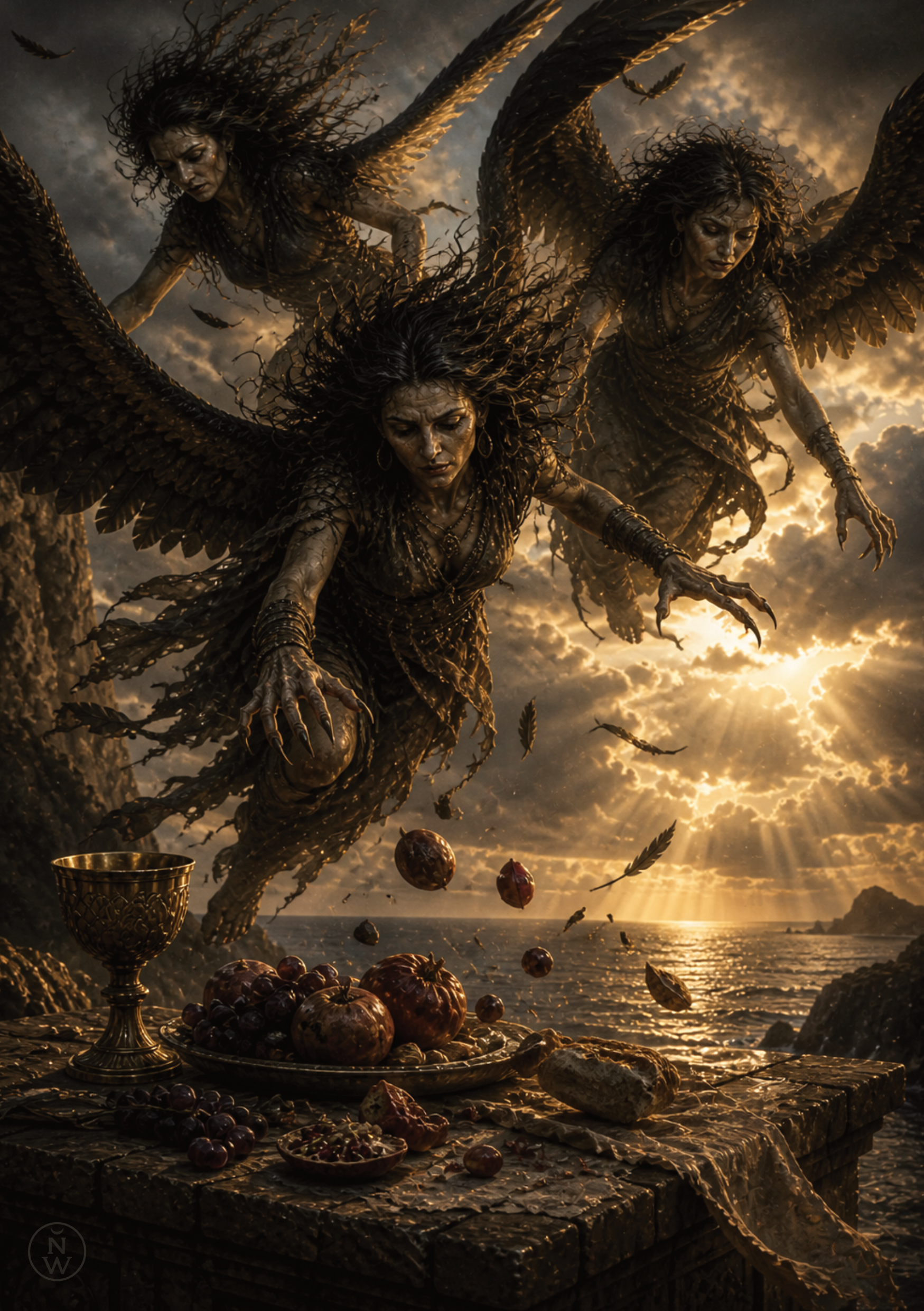
The Harpies arrive at the moment nourishment... and ensure it can no longer be taken in.
The Arrival of the Argonauts
Phineus’ torment continued until the arrival of Jason and the Argonauts, passing through on their journey.
They are not simply travellers passing through.
They arrive as movement.
A gathering of forces, each carrying a different skill, a different function — together able to intervene where one alone could not.
When the Harpies descended once more, the Boreads pursued them.
For the first time, the Harpies were not simply appearing and vanishing.
They were chased.
Driven away.
But not destroyed.
Instead, an agreement was made.
The Harpies would cease their torment of Phineus, and in return, they would be allowed to live.
Phineus, finally free from the cycle, was able to eat.
And in gratitude, he offered guidance to the Argonauts on their journey.
The Harpies in the Aeneid
The Harpies appear again in later myth, most notably in the Aeneid.
When Aeneas and his men land upon an island, they prepare a feast.
Once again…
the Harpies descend.
They snatch the food, spoil it, and drive the men away.
But this time, they do something more.
They speak.
One of them delivers a prophecy:
That the Trojans will suffer such hunger on their journey that they will be forced to eat their own tables before finding their home.
The Harpies then vanish.
Across both myths, the Harpies behave in a very specific way.
They do not wage war.
They do not guard treasure.
They do not hunt for survival.
They appear right at the moment of nourishment and then they interrupt it and remove or corrupt it.
And then they are gone.
But they leave behind hunger, frustration and something unresolved.
The Harpies do not bring destruction in the usual sense. They do not kill or conquer.
Instead, they appear at the threshold of fulfilment — and ensure that what is reached…
cannot be consumed.
What are the Harpies?
The Harpies are not constructed like many other creatures of myth.
They are not grounded.
They do not belong to the earth.
They are beings of air.
They are described as winged, fast, sudden, difficult to grasp and they are often depicted as part woman, part bird.
The symbolism of birds in myth often represent vision, perspective and movement between realms.
They exist between the earth and sky, the physical and unseen.
But the Harpies are not calm observers.
They do not glide.
They descend.
Sudden, sharp and uninvited.
They do not watch from above —they intervene from above.
The feminine aspect of the Harpies is also important, but not in the usual sense.
They are not nurturing, gentle or guiding.
They are instinctive, intuitive and unfiltered response.
They do not reason or explain.
They act.
The wind, the invisible force, is the most defining element of the Harpies.
They are spirits of the wind, which means they are unseen, unpredictable, impossible to contain and they are felt more than understood.
You cannot hold the wind, reason with it or stop it by force.
It moves where it must.
When we bring these elements together:
Bird (movement between realms)
Feminine (instinctive intelligence)
Wind (invisible force)
We begin to see that the Harpies are not creatures in the traditional sense.
They are movements.
The Harpies represent a sudden, unseen force that intervenes when something is about to be taken in…
but cannot be sustained.
When the Harpies appear in myth it gives us a clue as to their role.
Food in myth is not just survival.
It is sustenance, continuation or reinforcement.
So when the Harpies intervene, they are not simply taking food.
They are interrupting what is about to become part of the self.
The Harpies are the force that prevents something from being integrated when it no longer aligns.
They do not guide you away from it and they do not explain why.
They simply make it impossible to consume.
The Harpies are not beings of chaos, but of precision — appearing only at the moment something is about to sustain us, and ensuring that what cannot truly nourish…
is never taken in.
The Harpies are not just disruptors…
but truth delivered through discomfort.
Phineus - The King, the Seer & the Island
Phineus is not simply a victim of punishment.
He is a seer — someone who can perceive beyond the surface.
But in the myth, his ability to see becomes disconnected from his ability to live.
He knows…
but he cannot be nourished.
This is a crucial detail.
The punishment is not the removal of food. It is the removal of nourishment.
Food is present.
It is offered.
But it is never allowed to become part of him.
Symbolically, Phineus represents a state where perception has moved ahead of integration.
Where insight is present…
but cannot be sustained.
The island reinforces this.
He is not in the world as he was before. But he is not yet able to move forward.
He exists in between — a threshold state.
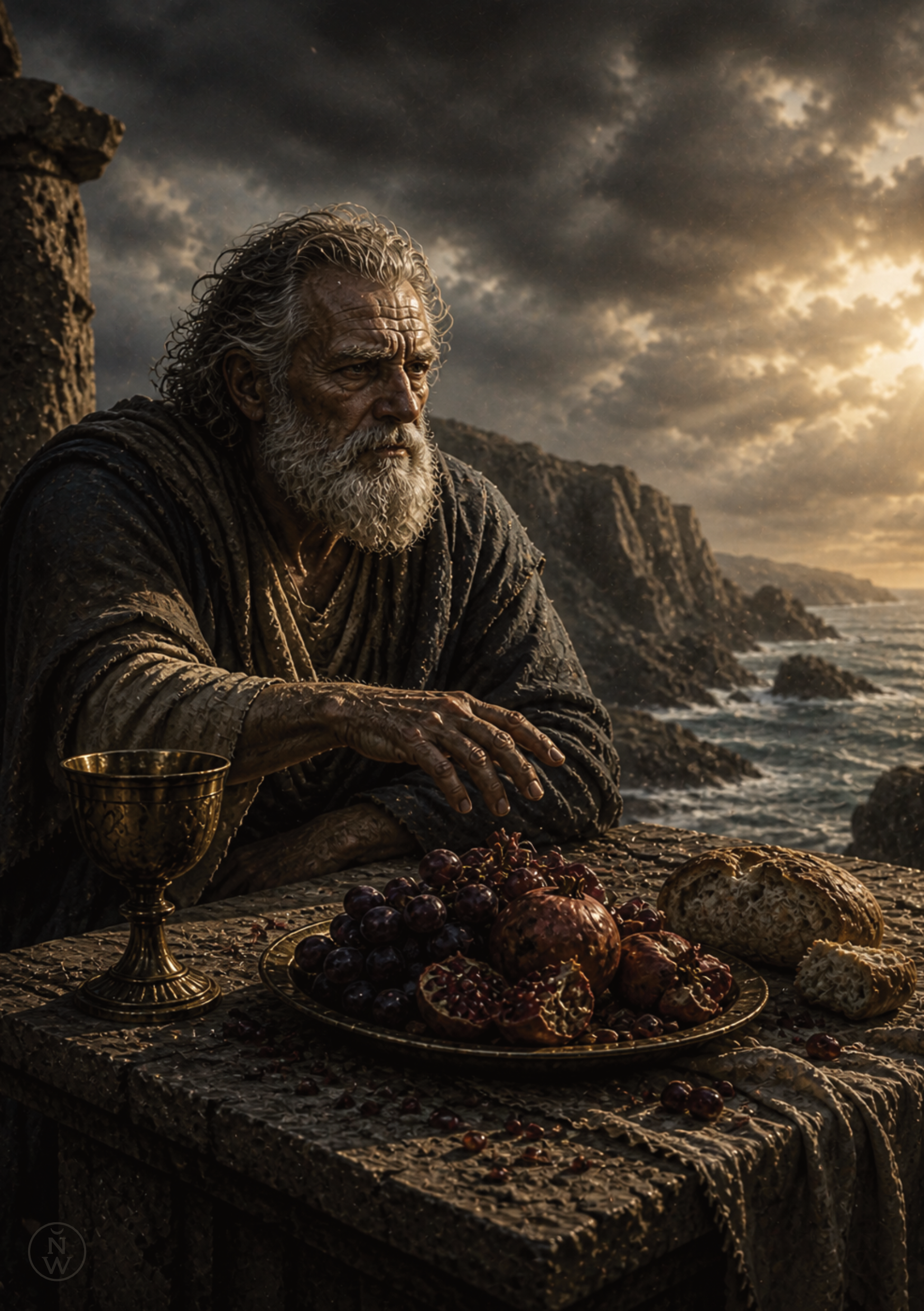
He can see clearly... but he cannot receive.
The Threshold - From Stagnation to Movement
Phineus does not move forward through effort.
There is no action he can take that resolves his condition.
Food is present.
Awareness is present.
But nothing nourishes.
And so the instinct is to do more.
To search for something new.
To find the next answer that will restore what has been lost.
But this is where the pattern deepens. Because the more he reaches, the more the cycle continues.
The shift does not come through effort.
It comes through stillness.
Not passive stillness, but the moment where the need to force a solution begins to fall away.
Where the reaching stops.
Where the search quiets.
This is the threshold.
A space that feels empty…
but is not.
Because it is here that something begins to change.
Not through action, but through the removal of interference. And it is only in this space that movement can return.
In the myth, this movement appears through the Boreads — Zetes and Calais, the winged sons of the North Wind.
They are not separate from what arrives.
They are part of the Argonauts. And it is through them that the first shift takes place.
They do not bring nourishment.
They do not solve the problem directly.
They clear the air.
They restore movement to what has become stagnant.
Only then…
does the full presence of the Argonauts take form.
This is an important distinction.
The Argonauts do not create the shift.
They do not rescue Phineus through force.
They represent a gathering of forces — each carrying a different function — that becomes effective once the system is ready to receive it.
The Boreads are the first movement within that system.
The clearing force that makes everything else possible.
Phineus does not free himself.
But neither is he saved by external intervention alone.
The shift begins within the system.
And once it has begun…
support can arrive.
This is the pattern.
In our own lives, there are moments where nothing seems to move.
Where we understand, but cannot act.
Where we search, but cannot find what we are looking for.
And yet, the more we search, the further we move from the shift itself.
Because movement does not always come from doing more.
Sometimes it comes from doing less.
From allowing space.
From letting the cycle reveal itself fully, without trying to escape it.
And then, often unexpectedly…
something changes.
Clarity returns.
A conversation appears.
A new direction opens.
The right support arrives.
Not because it was forced. But because it was finally able to enter.
The Argonauts do not come when we call them.
They come when we are ready to receive them.
What we cannot move alone…
often begins to move when we stop trying to move it.
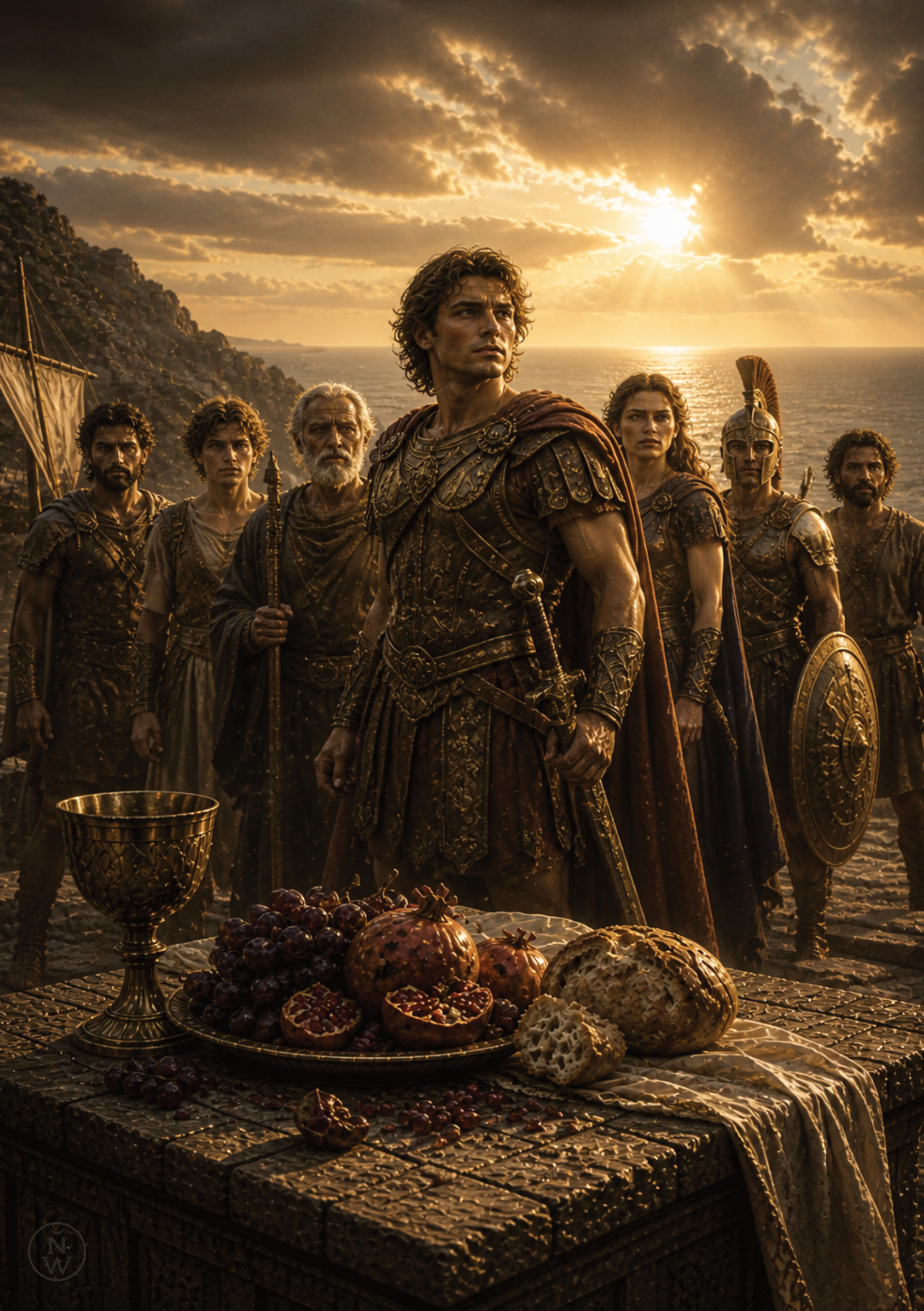
They do not come to rescue... but to support what is now ready to move.
The Boreads
The Boreads — Zetes and Calais, the winged sons of the North Wind, change the pattern.
They do not bring food.
They do not ‘heal” Phineus.
They pursue the Harpies.
For the first time, the cycle is interrupted. But what is important is this:
They do not destroy the Harpies.
They drive them away.
An agreement is made.
The force that disrupted nourishment is not eliminated — it is brought back into balance.
The Boreads are associated with the North Wind.
And when the North wind arrives it is strong, sudden and more importantly, it is clearing.
Like a shift in weather that moves through the atmosphere, removing what has become heavy or stagnant.
They represent movement.
Not through effort…
but through the removal of what prevents it.
There is an important detail in this myth that is often overlooked.
Why don’t the Boreads destroy the Harpies once and for all?
Why only drive them away?
An agreement was made — not to remove them from existence, but to end their interference.
The reason?
Because the Harpies are not something to be eliminated.
They are part of the system.
And like all such forces, they return when they are needed.
If the conditions that required them arise again — if what we take in once more no longer aligns — the interruption returns.
Not as punishment, but as correction.
What is not aligned does not need to be removed forever.
Only seen clearly enough that it no longer needs to return.
This pattern does not remain in myth.
It appears again — in different forms,
in different contexts,
but with the same structure.
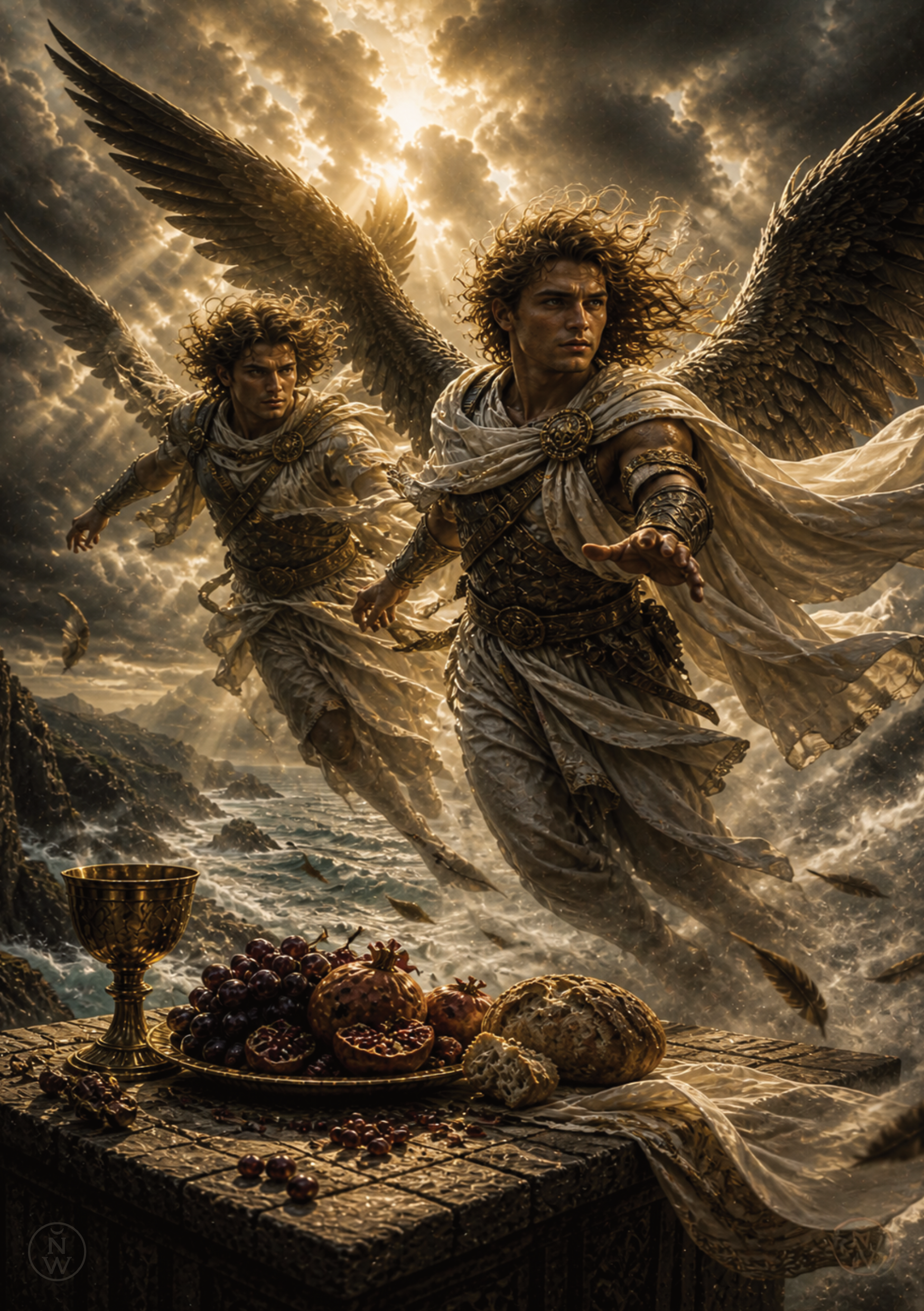
They do not bring nourishment... they clear the way for it to return.
Modern Reflection - When Nothing Nourishes
There is a point where this pattern appears in modern life.
The modern Phineus is someone who consumes endless information, understands deeply, speaks about awareness and sees patterns clearly.
But what once nourished…
no longer does.
We continue to read, to learn, to search.
But nothing lands in the same way as it once did.
The spark fades and the instinct is to search more.
Because the problem is no longer the absence of nourishment.
It is the inability to receive it.
And in continuing to search, we unknowingly deepen the cycle.
Like Phineus, food is present…
but it does not feed us.
And like the prophecy of the Harpies, the hunger can deepen to the point where we begin to consume everything…
without being nourished by anything.
The Harpies in modern terms can be loss of interest, frustration, the inability to engage with old habits and a sense of things feeling “off” or empty.
There comes a moment where the way forward is no longer through effort. But through space.
Clarity does not arrive through more input.
It arrives when something within us stops interfering long enough for it to move.
Like the wind that clears the sky, it cannot enter where there is no space.
The Harpies do not leave you empty.
They leave you ready.
And like the North Wind that clears the heavy sky, clarity does not come when we chase it —
but when the searching falls quiet, and what was always trying to reach us is finally able to move.
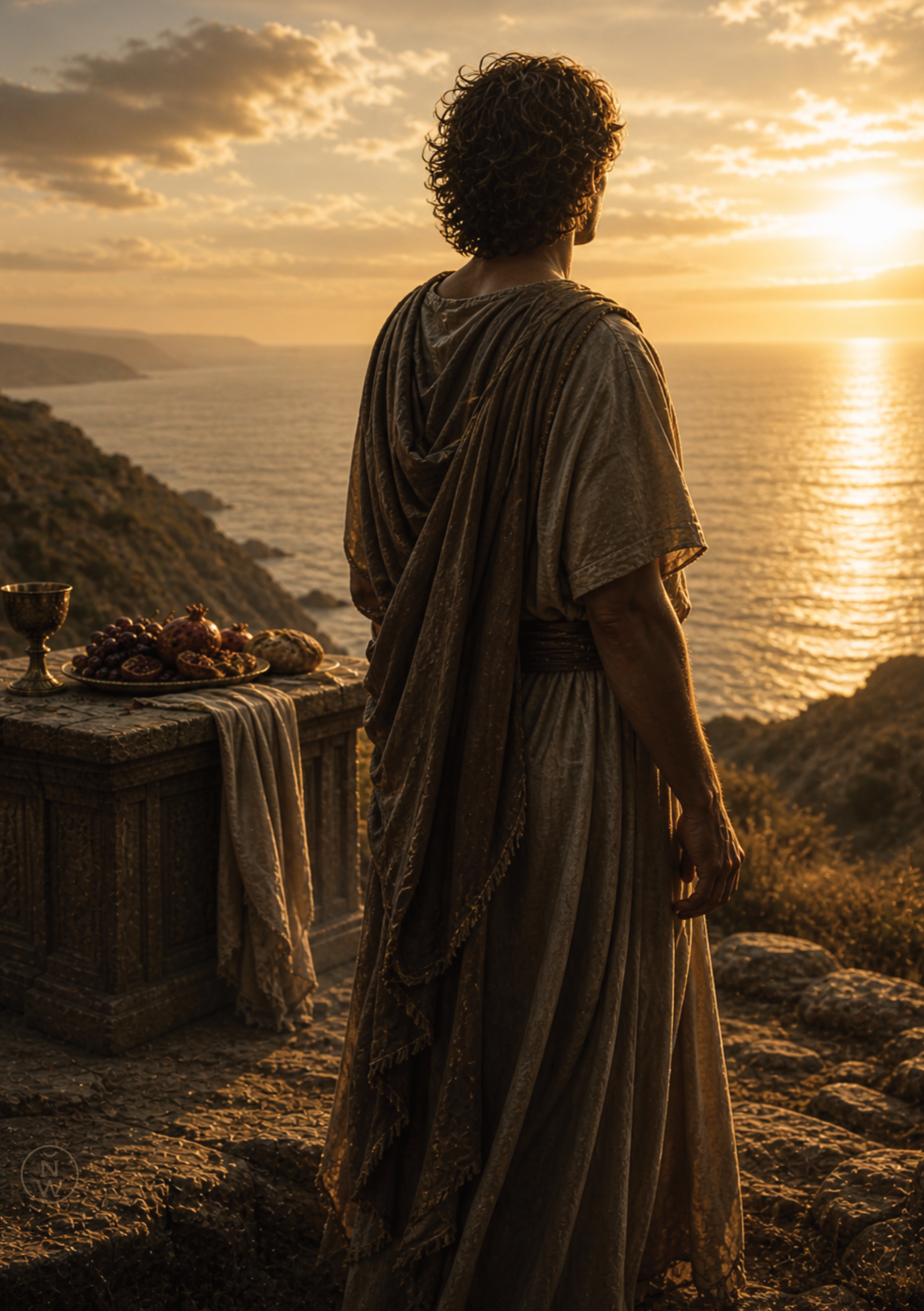
Nothing needs to be taken... and nothing needs to be forced.
Enter the Labyrinth
If nothing is nourishing you right now…
is it time to search more — or to finally make space?
Follow the Thread
Every myth reveals only part of the Labyrinth.
If the Harpies have invited you to explore what truly nourishes the soul, you may also wish to continue along these paths:
Continue the Journey
Watch the Film
Experience The Harpies - The Hidden Meaning of Disrupted Nourishment as a cinematic journey.
